Why your weight jumps around from day to day
Day-to-day weight moves by a kilogram or more with water, glycogen and gut content. How to read a weight trend instead of a single weigh-in.
What moves the scale day to day
Day-to-day changes are mostly water, glycogen and whatever’s in your gut. Each gram of stored glycogen binds roughly three grams of water. So a higher-carb day, a salty meal, a hard session or your menstrual cycle can move the scale a kilogram or more in a few days, with no change in fat.
Sweat works the other way, briefly. Weight you lose sweating is water, and it comes back when you drink.
Read the trend, not the day
A smoothed trend over at least two weeks filters out that noise. Frequent weigh-ins make the trend better, because each reading counts for less.
Say your morning weigh-ins read 81.9, 82.6, 81.7, 81.4, 82.1, 81.5 and 81.3 kg. The 0.7 kg jump on day two tells you very little by itself. Only the trend over two weeks or more shows whether you’re losing, holding or gaining.
- One weigh-in
- Trend, −0.42 kg a week over two weeks
How to weigh yourself consistently
Comparable readings give you a cleaner trend.
- Weigh at the same time of day, for example after you wake up and use the toilet.
- Use the same scale on the same hard floor.
- Log every reading, including the ones you don’t like. Skipping the high ones bends the trend.
When the change is real
If your two-week trend is moving the way you planned, at roughly the rate you planned, leave things alone. For fat loss, the evidence supports about 0.5–1% of bodyweight a week, slower if you’re already lean.
But a trend that’s been flat for a couple of weeks while your food logs were complete is a real signal. That one’s worth a look.
| Bodyweight | Slower end | Faster end |
|---|---|---|
| 60 kg | 0.30 kg | 0.60 kg |
| 70 kg | 0.35 kg | 0.70 kg |
| 80 kg | 0.40 kg | 0.80 kg |
| 90 kg | 0.45 kg | 0.90 kg |
| 100 kg | 0.50 kg | 1.00 kg |
In the app
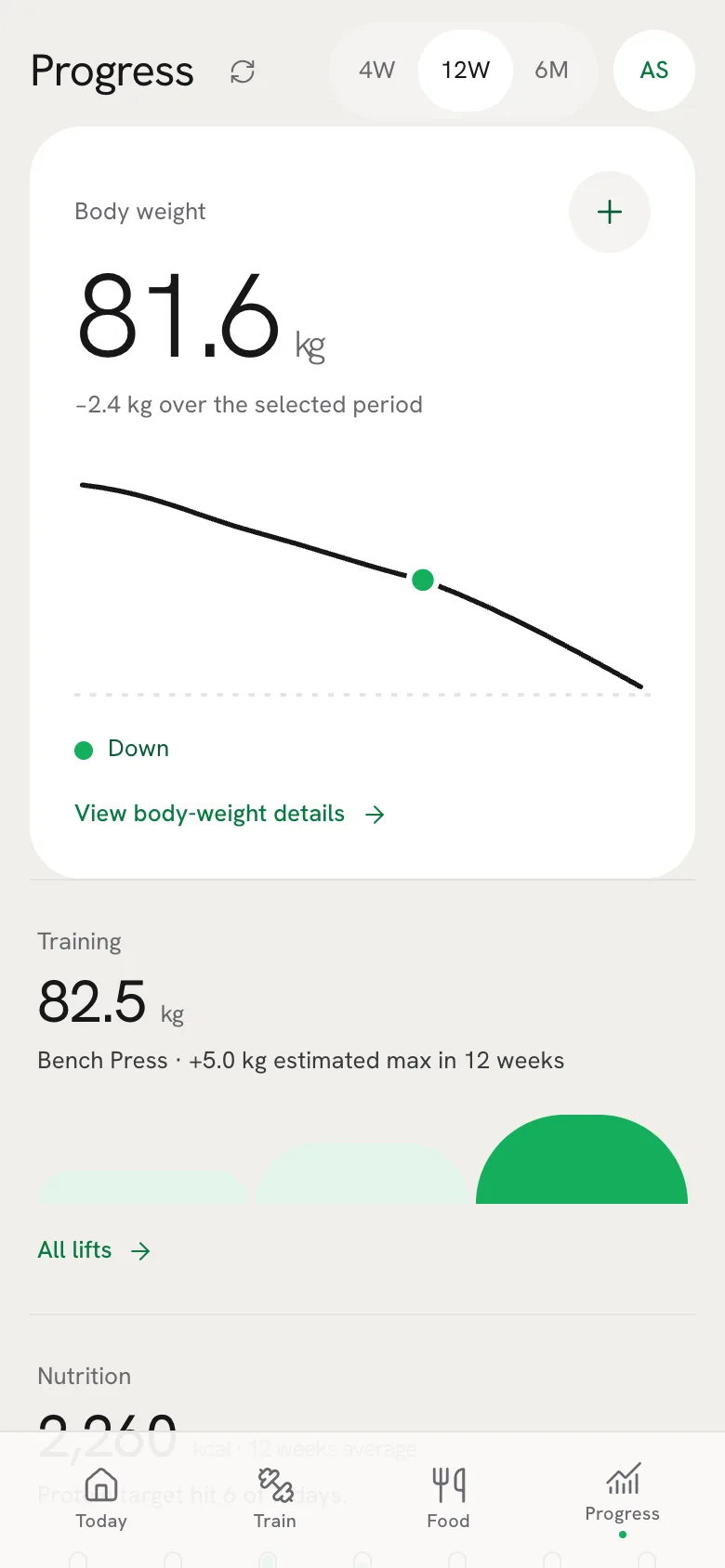
Progress shows your weight as a trend against your goal. Laroa won’t propose a calorie change from one weigh-in, and it treats a gap in your log as missing information rather than evidence.
Common questions
How much does weight fluctuate in a day?
A kilogram or more over a few days is common. Water, glycogen, salt, training and the menstrual cycle can all do it without any change in fat.
Should I weigh myself every day?
If it doesn’t upset you, yes. Frequent weigh-ins give a more reliable trend, because single readings count for less. Judge progress on at least two weeks of data.
The evidence behind this guide
Each claim above traces to an entry in Laroa’s evidence base (version 2026-10-17.1), which summarises position stands, guidelines and meta-analyses and grades how strong each one is.
- Daily weight noiseModerate evidence
- Weight change is not linearModerate evidence
- Rate of fat lossModerate evidence
Sources
- Kreitzman SN, Coxon AY, Szaz KF. Glycogen storage: illusions of easy weight loss, excessive weight regain, and distortions in estimates of body composition. Am J Clin Nutr. 1992;56(1 Suppl):292S-293S. doi:10.1093/ajcn/56.1.292S
- Hall KD, Sacks G, Chandramohan D, et al. Quantification of the effect of energy imbalance on bodyweight. Lancet. 2011;378(9793):826-837. doi:10.1016/S0140-6736(11)60812-X
- Trexler ET, Smith-Ryan AE, Norton LE. Metabolic adaptation to weight loss: implications for the athlete. J Int Soc Sports Nutr. 2014;11:7. doi:10.1186/1550-2783-11-7
- Helms ER, Aragon AA, Fitschen PJ. Evidence-based recommendations for natural bodybuilding contest preparation: nutrition and supplementation. J Int Soc Sports Nutr. 2014;11:20. doi:10.1186/1550-2783-11-20
- Sawka MN, Burke LM, Eichner ER, et al. American College of Sports Medicine position stand: exercise and fluid replacement. Med Sci Sports Exerc. 2007;39(2):377-390. doi:10.1249/mss.0b013e31802ca597
General information for healthy adults, not medical advice. If you have a medical condition, are pregnant, or have pain or warning symptoms, ask a clinician.